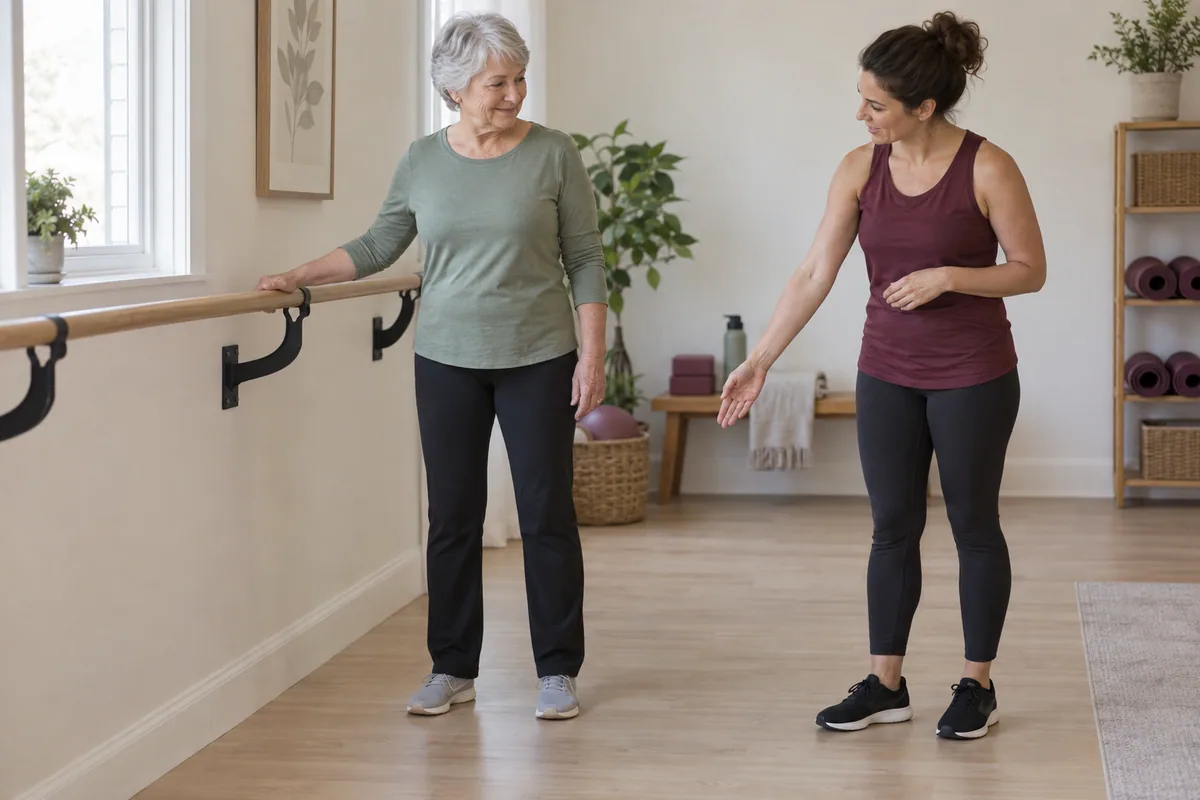
The plié is the single most important movement in barre. Every class starts with it, most sequences build on it, and the muscles it targets — quads, inner thighs, glutes, calves — are the ones that create the lean, defined lower body barre is known for. This workout takes the plié through seven progressions that go from manageable to "my legs are shaking and I can't stand up." All you need is a chair.
What Is a Plié?
Plié (pronounced plee-AY) is the French word for "bent." In ballet, a plié is a controlled bend of the knees while the torso stays upright. In barre fitness, the plié is the foundation of virtually every lower-body exercise — it's how you load the quads, engage the inner thighs, fire the glutes, and challenge the calves, all in a single movement.
The plié can be performed in several foot positions, but second position — feet wider than shoulder width, toes turned out — is the most common in barre workouts. Second position creates a wider base of support, increases inner thigh engagement, and allows for a deeper range of motion than narrower stances. It's also more accessible for beginners because the wider base makes balance easier.
This entire workout uses second position pliés and their progressions. If you've never done a plié before, read the setup section carefully — the position of your feet, knees, and pelvis determines whether the exercise targets the right muscles or stresses the wrong joints.
What You Need
Sturdy Chair
Counter or desk works too
Bare Feet or Grip Socks
Never shoes
Water
You'll need it by exercise 4
How to Set Up Your Plié
Your setup determines everything. A properly aligned plié targets the muscles it's designed to work. A misaligned plié puts stress on the knees and lower back. Take 30 seconds to get this right before you start.
Foot placement: Stand with your feet wider than hip-width apart — roughly 3 to 3.5 feet depending on your height. Point your toes outward at about 45 degrees each (90 degrees total turnout). The turnout should come from your hips, not your ankles. If your knees drift inward when you bend, your turnout is too wide — narrow it until your knees track directly over your toes.
Weight distribution: Shift your weight back into your heels. You should be able to wiggle your toes at any point during the workout. If your weight is in your toes, your quads are overloaded and your glutes are underloaded. Heels down, weight back.
Posture: Stand tall. Shoulders stacked over hips, hips over heels. Roll your shoulders back and down, away from your ears. Your spine is long and neutral. One hand rests lightly on the back of your chair — light enough that you could lift it off at any time. The chair is for balance, not support.
The tuck: Before you begin any exercise, engage your core and find your posterior pelvic tilt. Draw your belly button toward your spine, tilt your pelvis slightly under, and feel your lower abs and glutes activate. Hold this throughout every exercise. If you lose the tuck, reset it before continuing.
The Workout — 7 Exercises, No Rest
Perform these exercises in order, moving directly from one to the next without stopping. The sequence is designed as a progressive overload — each exercise builds fatigue on the muscles already worked by the previous one. By exercise 5, you'll understand why barre people say "embrace the shake."
Full Range Plié
From your setup position, bend your knees and lower your body straight down, keeping your torso completely upright — imagine sliding down a wall. Lower until your thighs are as close to parallel with the floor as your mobility allows, then press through your heels to return to standing. Your knees stay wide, tracking over your toes throughout the movement. Don't lock your knees at the top — keep a slight softness so the muscles stay loaded.
Plié Pulse
Lower into your deepest plié and hold at the bottom. From there, pulse — rise up one to two inches, then lower back down one to two inches. The range of motion is tiny. Your thighs never come above parallel and you never fully stand up. This is isometric work with a micro-movement overlay, and it creates the sustained muscle tension that barre is built on. Twenty reps. Don't come up early.
Single Heel Lift Plié
Return to standing in your turned-out second position. Lift your right heel off the floor — just the heel, the ball of your foot stays down. Now perform a full plié while keeping that heel elevated. The lifted heel forces the calf of that leg to work continuously while your quads and inner thighs handle the plié. Press back to standing but keep the heel lifted throughout all 10 reps. Then switch sides.
Single Heel Lift Pulse
Stay in your plié with one heel lifted. Pulse at the bottom — same tiny one-to-two-inch range as exercise 2, but now with the added calf engagement of the lifted heel. This is where you'll feel the first real burn. Your standing leg calf, both quads, both inner thighs, and your core are all working simultaneously. Ten pulses per side. Breathe.
Low Plié Heel Marches
Lower into your deepest plié and hold. Without rising at all, lift your right heel off the floor, then lower it. Lift your left heel, then lower it. Alternate — right, left, right, left — like slow marching in place while staying in the bottom of your plié. This isolates the calves one at a time while the quads and inner thighs hold the plié position isometrically. Ten lifts per side.
Double Heel Lift Plié
This is the peak exercise. From your low plié, lift both heels off the floor simultaneously — you're now balancing on the balls of both feet in a deep squat. Rise both heels up an inch, lower them an inch. The entire time, you stay low in the plié. Both calves, both quads, both inner thighs, glutes, core, and the small stabilizer muscles of your feet and ankles are all firing. Fifteen reps. Your legs will be shaking by rep 8 — that's exactly what's supposed to happen.
Isometric Plié Hold
The finisher. Lower into your deepest plié — thighs as close to parallel as you can manage — and hold. Don't move. Both feet flat on the floor, weight in your heels, spine tall, tuck engaged. Hold for 30 seconds. If it feels manageable, sink an inch lower. If your legs are screaming, you're at the right depth. Breathe through it. When the 30 seconds are up, slowly stand and shake your legs out.
After the Workout — Stretch
Your quads, inner thighs, and calves just did significant work under sustained tension. Skipping the stretch means tighter muscles tomorrow and less range of motion in your next session. Take three minutes for these three stretches.
Standing quad stretch: Hold your chair with one hand. Bend one knee and grab your foot behind you with the opposite hand, pulling your heel toward your glute. Keep your knees together and your pelvis tucked. Hold 30 seconds each side.
Wide-stance forward fold: From your second position setup, straighten your legs and fold forward from the hips, reaching your hands toward the floor. Let your head hang heavy. You'll feel this in your inner thighs and hamstrings. Hold 30 seconds.
Calf stretch: Face your chair, step one foot back about two feet, and press that heel into the floor while leaning slightly forward. Keep the back leg straight. Hold 30 seconds each side.
Want More Barre Workouts?
This plié sequence is one small piece of a full barre class. Try a complete workout with an instructor who watches your form.
How to Modify
Every exercise in this workout can be scaled to your current level. The key variable is depth — the deeper you plié, the harder it gets. Here's how to adjust.
Beginner: Perform shallower pliés — your thighs don't need to reach parallel. Skip exercises 5 and 6 (the heel lifts in plié) until your ankle stability improves. Reduce all reps by half. Take a 15-second rest between exercises if needed.
Intermediate: Perform the workout as written. Focus on depth — thighs to parallel on every rep. Add a second round if the first round doesn't create significant fatigue by exercise 5.
Advanced: Increase all rep counts by 50%. Extend the isometric hold to 45-60 seconds. Add light dumbbells (2-3 lbs) held at shoulder height during exercises 1 and 2 — this adds upper body work and forces the core to stabilize more aggressively. Or perform the entire workout in relevé (heels lifted), which transforms every exercise into a balance and calf challenge.
How to Progress
Do this workout 2-3 times per week. Here's a realistic progression timeline for most people.
Weeks 1-2: Focus on form. Get the setup perfect — turnout from hips, knees tracking over toes, weight in heels, tuck engaged. Don't chase depth. Correct alignment at a shallow depth is better than sloppy form at a deep depth.
Weeks 3-4: Increase depth. Work toward thighs at parallel on every rep. The shaking should start around exercise 4 or 5. If you're not shaking by exercise 6, you need to go deeper.
Weeks 5-8: Add a second round. Rest 60 seconds between rounds. By the end of the second round, your legs should be at their limit. If you can do a third round, your form is probably breaking down — stay at two rounds with perfect form rather than three rounds with compromised alignment.
Beyond 8 weeks: This workout alone will plateau. Your muscles have adapted to this specific stimulus. This is when a live barre class with a certified instructor adds value — they'll introduce variations, tempos, positions, and sequences that keep your muscles progressing. The plié is one of dozens of foundational movements in a full barre vocabulary.
What This Workout Targets
The plié is a compound movement — it works multiple muscle groups simultaneously. Here's what's firing during this workout and why.
Quadriceps: The front of the thigh. Loaded throughout every plié as they control the descent and power the ascent. The pulse exercises create sustained quad tension that heavy squats don't replicate — it's why barre builds muscular endurance rather than max strength.
Inner thighs (adductors): The wide second-position stance puts the adductors on stretch at the bottom of the plié and requires them to engage throughout the movement to maintain the turnout. This is the muscle group most people feel working first.
Glutes: Especially when the tuck is maintained. The posterior pelvic tilt activates the glutes and keeps them engaged throughout the standing work. Without the tuck, the glutes are passengers in a plié. With the tuck, they're co-drivers.
Calves: Directly targeted in exercises 3 through 6 (the heel lift variations). The relevé position creates calf work that compounds with the thigh and glute work already happening in the plié, which is why the heel lift exercises feel so much harder than the basic plié.
Core: Your transverse abdominis, obliques, and pelvic floor are active the entire workout — they have to be to maintain the tuck and keep the torso upright while the lower body is under load. This is the "hidden" core workout inside every barre session — you never do a crunch, but your deep core muscles get 15 minutes of sustained engagement.
Frequently Asked Questions
How often should I do this workout?
Two to three times per week with at least one rest day between sessions. Your muscles need recovery time to repair and adapt. Daily plié work without rest leads to diminishing returns and overuse soreness in the knees and inner thighs.
My knees hurt during pliés — what's wrong?
Almost always an alignment issue, not a plié issue. The two most common causes: (1) knees collapsing inward instead of tracking over the toes — narrow your turnout until your knees stay wide, and (2) weight shifting forward into the toes, which loads the front of the knee joint. Shift your weight back into your heels. If knee pain persists with correct alignment, consult a physical therapist before continuing.
Can I do this workout if I'm pregnant?
Pliés are generally well-suited for pregnancy because they strengthen the muscles that support the pelvis and pelvic floor. However, modifications change by trimester — particularly around balance, range of motion, and the tuck. Work with an instructor who holds an IBBFA Prenatal & Postnatal specialty certification rather than following a generic workout. Always consult your healthcare provider before starting or continuing exercise during pregnancy.
Is this workout enough for a full lower-body session?
As a standalone, it's a focused quad and inner-thigh burn — excellent for a 15-minute targeted session. A complete barre lower-body workout would also include arabesque and attitude work (glute-focused), tendu and dégagé series (hip flexors and outer thighs), and targeted calf work in parallel position. A live barre class covers all of these in a single session.
Why do my legs shake so much?
The shaking is muscle fatigue tremor — your muscle fibers are fatiguing one by one, and your nervous system is rapidly cycling through remaining fibers to maintain the position. It means the workout is working exactly as designed. The more you practice, the longer it takes for the shaking to start — that's measurable progress.
What's the difference between a plié and a squat?
A squat uses a parallel foot position (toes forward) and loads primarily through the quads and glutes. A plié uses a turned-out foot position (toes angled outward) and adds significant inner thigh engagement because the adductors must work to maintain the turnout under load. The plié also typically uses a narrower range of motion and higher rep count than a squat, prioritizing muscular endurance over max strength. They complement each other — doing both is better than doing either alone.