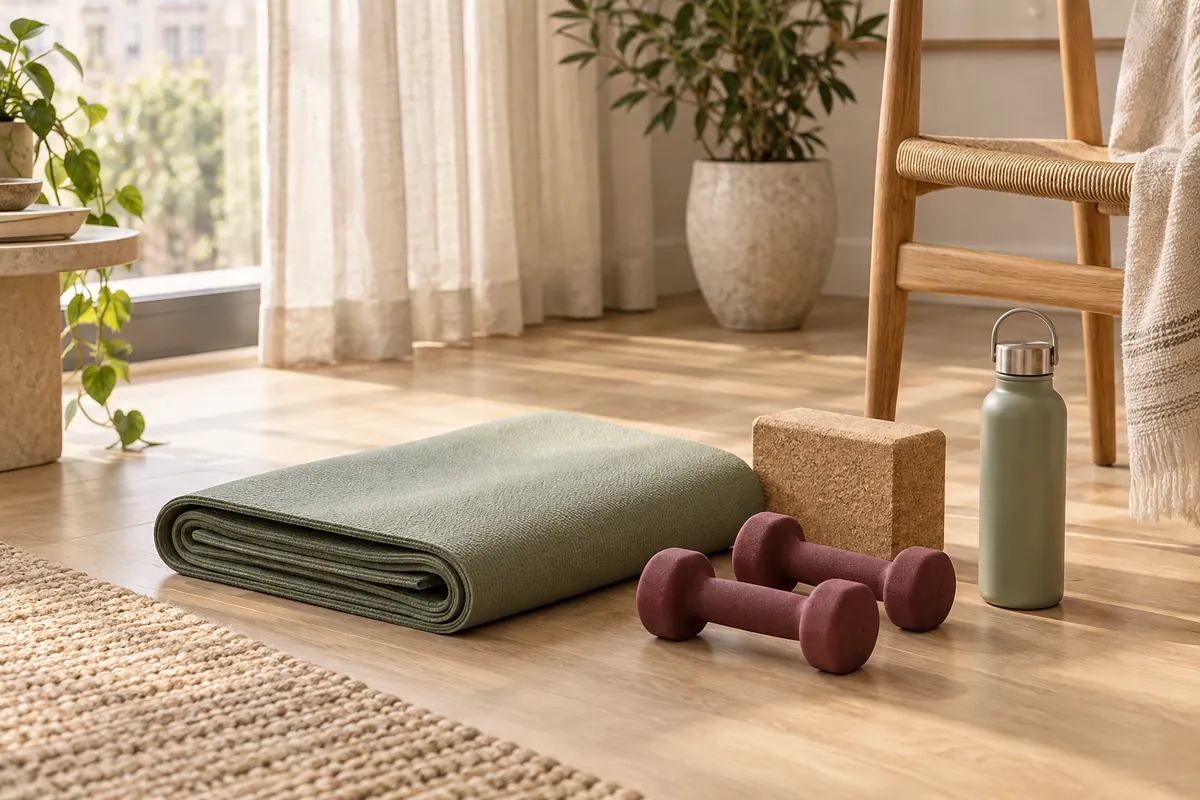
Start with the equipment list for the class you want to take. Some barre sessions use only body weight and a stable support. Others require a mat, dumbbells, a resistance band or a ball. The instructor should make required and optional items clear.
Before buying equipment, compare ways to train at home so your setup matches the format you will actually use.
A stable support
If a class uses a chair or counter, check that it cannot roll, fold, slide or tip during the intended movement. A household chair is not designed to act as an anchor for pulling your full body weight. If a movement requires more support than your setup provides, ask the instructor for an appropriate alternative.
Clear the space around the support. You should be able to move without reaching around furniture, stepping over cables or brushing against nearby objects.
Weights and bands
Use the type of resistance specified by the session. Different bands vary in length, resistance and intended use; follow the manufacturer’s instructions and inspect them for damage. Do not substitute knotted clothing for purpose-made resistance equipment.
The right choice depends on the exercise, your ability to control it and the program’s progression. A smaller weight is not automatically the best choice for every exercise.
Mat and floor space
If the class includes floor work, use a surface that suits the movements and does not slide. Check that you can get down and up in the available space. If you prefer a session without those transitions, choose a format explicitly described as standing.
Equipment alone does not solve movement discomfort.
Screen camera and sound
Position the screen so you can follow the instructor without repeatedly turning your head away from the exercise. For a live class, test the camera view and ask what the instructor needs to see. Ensure the device is stable and cannot fall when you move nearby.
Keep instructions easy to hear. If you need captions or another communication adjustment, ask whether the actual class can provide it before booking.
Clothing and footwear
Choose clothing that lets you move comfortably and follow the session’s footwear guidance. The floor surface, movement and any individual requirements matter; there is no single rule that every participant must be barefoot or wear grip socks.
Your quick setup check
- Required equipment matches the class description.
- Support is stable for the intended use.
- Movement space and floor are clear.
- Screen, sound and any required camera are ready.
- You know how to ask for an alternative if a movement does not suit you.
Buy additional props only when they serve a specific exercise or progression you plan to use.
Match the equipment to the format
Use the barre without weights guide to preview a bodyweight option before buying equipment. If progressive resistance is your goal, read the Barre & Strength format questions and wait for a specific session’s equipment list. That format is in planning; owning the suggested equipment does not reserve a class place.
How high should a barre be?
Use a height that fits the exercise, your reach and the equipment’s instructions; there is no single correct height for every person and task. Follow the specific manufacturer’s fitting and installation guidance rather than choosing a universal height.
Products also differ. The current US Harlequin Studio Series specifications list a lower rail at 31 inches and an upper rail at 40 inches. Check the actual model, rail measurement and intended use before buying. Ask your instructor to confirm the setup for the specific movements; a rail for light balance contact is not automatically an anchor for pulling or suspending body weight.
If the height or support feels unsuitable, clarify the setup rather than raising furniture on loose objects or improvising a mounting. Follow the manufacturer’s assembly and fixing instructions, including suitable wall construction and fasteners where relevant.
Can I do barre at home without a bar?
Yes, if you choose a session designed without one or the teacher confirms an appropriate alternative for its actual tasks. The no-equipment resource guide helps you look for that format. A class that needs a fixed rail, pulling resistance or another specific setup is a different choice.
Ask whether a stable support is needed for light balance, whether any weight is transferred into it and whether the full session fits your setup. A wheeled chair or unstable item is unsuitable. Do not assume every chair or countertop replaces a barre simply because it is nearby.