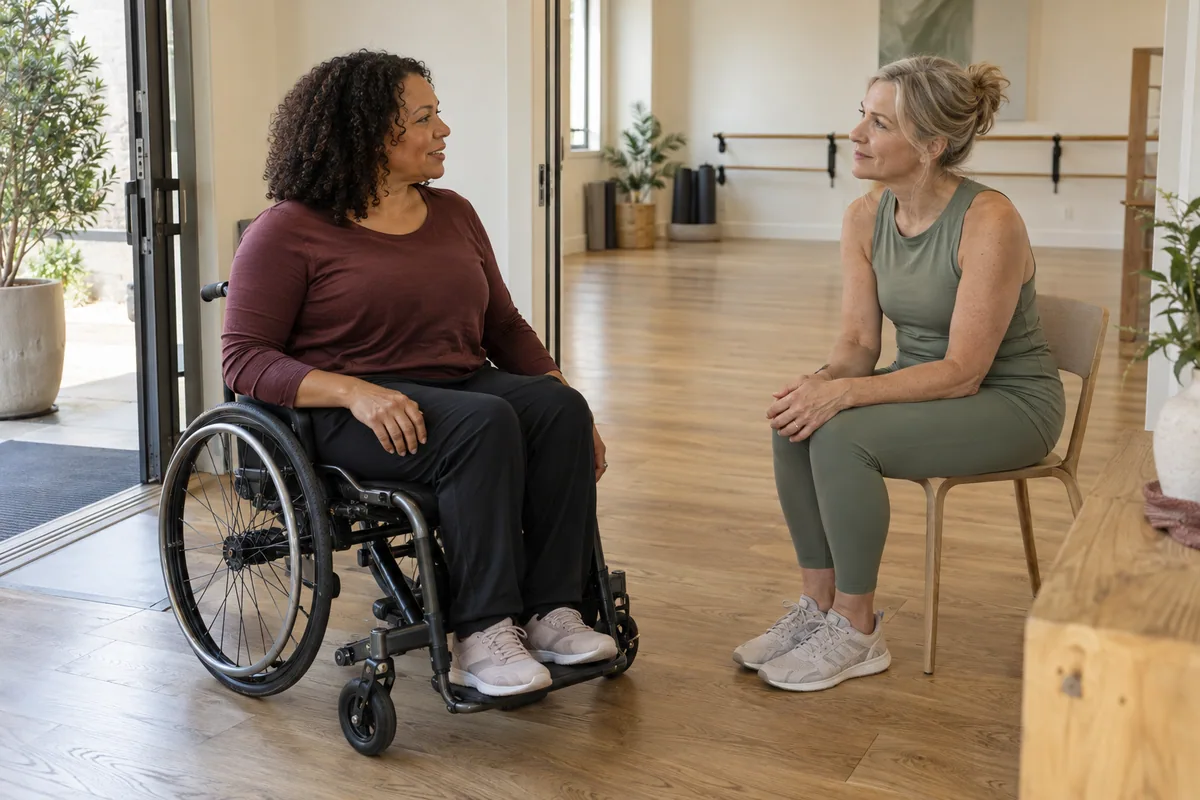
Barre for People with Disabilities: Yes, It's for You

If you've been wondering whether barre is something you can do — with a wheelchair, with chronic pain, with limited mobility, with a condition that makes most gym classes feel like they weren't designed for you — the short answer is yes. Barre is one of the most adaptable fitness formats that exists, and this page will show you exactly how it works for your body.

Quick answer

Barre adapts to you, not the other way around. Every exercise has a seated version, no movement requires jumping or getting on the floor, and intensity scales to whatever your body can do today. Chair barre is a full workout format — not a lesser version of the "real" thing.

Why Barre Works When Other Workouts Don't

Most group fitness classes are designed for a narrow range of bodies and abilities. The instructor demonstrates a movement, everyone does the same thing, and modifications are an afterthought — if they're offered at all. Barre is structurally different:

It's built on isometric movement

Isometric exercise means holding a position and contracting muscles without large joint movements. If your mobility is limited — whether by a spinal cord injury, arthritis, cerebral palsy, multiple sclerosis, an amputation, or any other condition — isometric holds let you build real strength within whatever range of motion you have.

Every exercise has a seated version

A wheelchair, a sturdy chair, or a bench serves the same purpose as the ballet barre. The arm series, core engagement, upper body work, and many lower body exercises can all be performed seated. You're not doing a watered-down version — seated barre is a legitimate format that challenges muscles to fatigue.

It's low-impact by design

There's no jumping, no running, no plyometrics. The movements are small, controlled, and precise. This makes barre safe for people with joint conditions, chronic pain, osteoporosis, or prosthetics — situations where high-impact exercise is contraindicated.

Intensity scales in both directions

A beginner doing a basic plié with both hands on the barre is doing fundamentally the same exercise as an advanced student doing a single-leg plié in relevé. The movement pattern is identical — the difficulty comes from body position, not external load. You progress at your own pace without needing separate "adaptive" exercises.

How Barre Adapts to Different Disabilities

Wheelchair Users and Limited Lower Body Mobility

Barre's upper body and core work translates directly to your life. The arm series — shoulder presses, bicep curls, lateral raises, all with light weights and high reps — builds the shoulder endurance you need for propulsion. Core engagement exercises (the "tuck" and abdominal holds) strengthen the trunk stability that supports posture and prevents shoulder overuse injuries.

What it looks like: A qualified instructor can lead an entire 30-minute session from a seated position that works your arms, shoulders, chest, back, and core to genuine fatigue. Many seated barre exercises are actually more challenging for the core because you can't use your legs for stabilization.

Chronic Pain and Autoimmune Conditions

If you live with fibromyalgia, rheumatoid arthritis, lupus, or other chronic pain conditions, the unpredictability of flare-ups makes committing to exercise difficult. Barre's scalability is the key — on a good day, push deeper into holds and add small weights. On a flare day, reduce range of motion and focus on gentle stretching. The workout adjusts to how your body feels today without requiring you to skip entirely.

Why it works: The low-impact isometric approach strengthens muscles without the jarring forces that provoke inflammatory responses. Regular, gentle movement tends to reduce chronic pain over time compared to inactivity, which increases stiffness and deconditioning.

Neurological Conditions (MS, Parkinson's, Stroke Recovery)

These conditions often affect balance, coordination, and fine motor control. Barre directly trains all three. The balance work can be done with both hands on the barre or chair for full support. The small, precise movements — tiny pulses, controlled holds — challenge the neuromuscular connections that neurological conditions can weaken.

For Parkinson's specifically: The rhythmic, music-driven nature of barre class has a similar effect to dance-based movement therapies that research has shown improve gait, balance, and quality of life.

Amputees and Limb Differences

Barre adapts to asymmetrical bodies. If you have a lower limb difference, the barre provides balance support that lets you safely work the standing leg while engaging the residual limb and core for stability. Upper limb differences can be accommodated by using one arm, changing the grip, or substituting resistance bands for weights.

The deeper value: Barre's focus on body awareness is especially useful here — learning to feel how your body distributes weight, where your center of gravity lives, and how to stabilize from the core outward.

Visual and Hearing Impairments

Barre classes follow a consistent structure — warm-up, arms, thighs, seat (glutes), abs, stretching — that becomes predictable quickly. For people with visual impairments, the fixed barre provides a spatial anchor, and verbal cueing in barre is more detailed than most fitness classes. For people who are deaf or hard of hearing, barre's visual predictability and rhythmic movements make it possible to follow along even without hearing every cue. Virtual classes with captions are increasingly available.

What to Expect in Your First Class

Walking — or rolling — into any fitness class for the first time is intimidating. Here's what to expect:

Before class

Contact the instructor ahead of time. Tell them about your disability, what movements you can and can't do, and any medical considerations. A good instructor will ask questions, plan modifications in advance, and make you feel like a regular participant — not a problem to solve.

During class: Expect to do some version of every exercise — not sit out while the class works around you. The barre (or chair) is your primary support. If something doesn't work for your body, a skilled instructor will offer an alternative on the spot — not a lesser version, but a different path to the same muscle engagement.

After class: You'll feel it. Barre creates the distinctive "barre shake" — a trembling in the muscles that signals you've worked them to fatigue. This happens regardless of ability level and is a sign the workout is effective, not that something is wrong.

What you don't need: Dance experience (barre is not ballet), perfect balance (the barre is there for support), or any particular fitness level. Barre meets you where you are.

Start with a Free Workout at Home

Try barre in your own space first — no signup, no equipment. Our beginner collection includes options you can do seated.

Beginner Workouts → No Equipment

Chair Barre: A Full Workout from a Seated Position

Chair barre is a complete barre class performed entirely from a chair or wheelchair. It's not a modification — it's a format.

0–3 min

Warm-Up

Seated spinal articulation (cat-cow in a chair), shoulder rolls, wrist circles, gentle neck stretches. Gets blood flowing and prepares joints for movement.

3–9 min

Arm Series

Light weights (1–2 lbs) or no weight. Bicep curls, overhead presses, lateral raises, front raises — all with high reps (20–30) and small, controlled movements. The "pulse" at the top is where the isometric challenge lives. Your arms will shake. That's the point.

9–15 min

Core Work

Seated tuck (pulling navel to spine while tilting the pelvis), oblique twists, seated crunch variations. For wheelchair users, this directly strengthens trunk muscles that support seated posture and upper body function.

15–20 min

Upper Back and Posture

Seated row motions (with resistance bands or light weights), chest openers, rear delt flies. Counteracts forward-rounded posture and strengthens muscles supporting shoulders during wheelchair propulsion.

20–25 min

Lower Body (if applicable)

For those with some lower body function: seated leg extensions, inner thigh squeezes with a small ball, ankle pumps, gentle leg lifts. Maintains circulation, range of motion, and muscle tone.

25–30 min

Stretching and Cool-Down

Seated forward fold, cross-body shoulder stretch, neck release, wrist stretches. Deep breathing to bring the heart rate down.

How to Find an Instructor Who Gets It

Not every barre instructor has experience working with people with disabilities. Here's how to find one who does:

Ask about adaptive experience. When contacting an instructor, ask directly: "Have you worked with clients who have [your specific condition]?" An honest instructor will tell you what they know and what they don't. Someone who says "I can work with anyone" without asking questions is a yellow flag — the good ones want to understand your specific needs before class starts.

Look for Special Populations training. IBBFA's Special Populations & Contraindications specialty covers contraindication recognition, senior and active aging programming, post-rehab adaptations, and client intake screening — the skills an instructor needs to work safely with diverse abilities.

Try virtual first. A live virtual class lets you try barre from your own space, with your own setup, without the logistical challenges of getting to a studio. The instructor can see your form and give real-time corrections while you use whatever support structure works best at home.

Find an Instructor Who Can Work with You

Browse certified instructors offering live virtual barre classes. Filter by specialty to find someone with adaptive training.

Special Populations Instructors →

The Benefits Are Real — and They Compound

Reduced secondary health risks. Sedentary lifestyles increase the risk of cardiovascular disease, type 2 diabetes, pressure injuries, and depression. Even moderate activity — like a 20-minute chair barre session three times a week — meaningfully reduces these risks. Barre removes the most common barrier (lack of accessible exercise options) and replaces it with something you can do from any chair, anywhere.

Improved body awareness. Barre's precise, small movements develop proprioception — your sense of where your body is in space. For people with neurological conditions, this can translate to better balance, fewer falls, and more confident movement in daily life.

Mental health and community. In a live virtual class, you're working alongside other people, getting encouragement from an instructor who knows your name, and experiencing the communal endurance of holding a position until your muscles shake. That sense of belonging and achievement matters, especially if other fitness spaces haven't felt welcoming.

Frequently Asked Questions

Can I really do barre from a wheelchair?

Yes. Chair barre is a full workout format — arms, core, back, and (depending on your function) lower body. The chair or wheelchair replaces the barre as your support structure. Many seated exercises are actually more challenging for the core because you can't use your legs for stabilization, forcing trunk muscles to work harder.

I have chronic pain. Won't barre make it worse?

Barre is low-impact and fully scalable. On flare days, reduce range of motion, skip the weights, and focus on gentle stretching. On better days, push harder. Regular, gentle movement tends to reduce chronic pain over time compared to inactivity. Always consult your physician if you're starting a new exercise program with a pain condition.

Do I need to tell the instructor about my disability?

Yes — and a good instructor will appreciate it. Knowing your situation in advance lets them plan modifications, avoid movements that could cause problems, and focus attention where it's most helpful. This isn't about limiting you — it's about making the experience better and safer.

What if I can only use one arm?

The arm series adapts easily. Single-arm work is actually a more advanced technique used in standard barre classes for added challenge. The instructor adjusts weight and rep count accordingly. Resistance bands anchored to the wheelchair or chair frame offer additional options.

Will I feel out of place in a class with non-disabled people?

In barre, everyone looks different. A 25-year-old dancer and a 65-year-old beginner do the same exercises at different levels in the same class — that's how barre is designed. Your modifications aren't a special accommodation — they're just your version of the workout, the same way everyone else is doing their version. In a well-taught class, nobody is watching you. They're too busy shaking.

How do I get started if I've never exercised before?

Start with a free beginner video at home. Use a chair for support. Go slowly. If 20 minutes feels like too much, do 10 minutes. Consistency matters more than duration — doing 10 minutes three times a week is better than doing nothing because 30 minutes feels too hard. When you're comfortable with the basics, try a live virtual class for personalized guidance. Our free workouts page and barre glossary are good places to start.

Barre Adapts to You

Find an instructor trained in adaptive modifications, or try a free workout to see the format.

Special Populations Instructors → Free Workouts