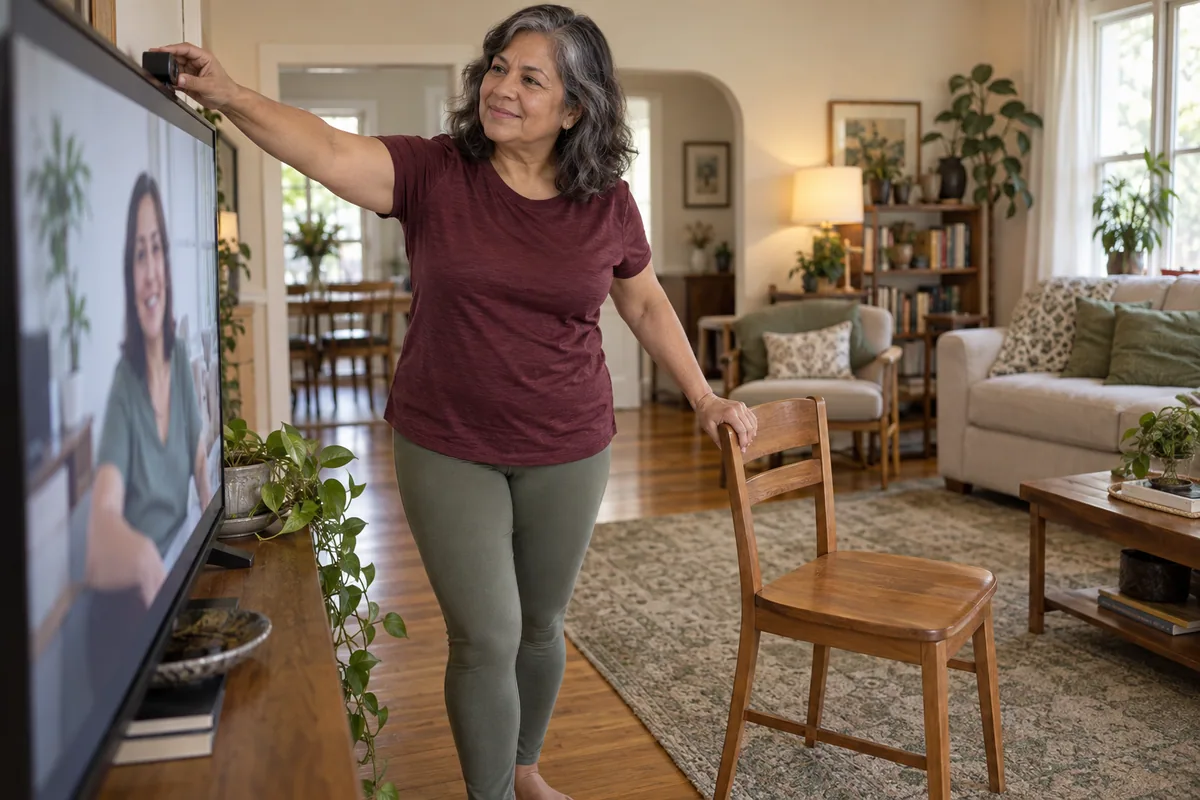
The best online fitness class for you after 50 is one you can attend, understand and use with the space and equipment you have. Start by choosing the support you want: a recording you can pause, a live appointment with a group, or time devoted to you with a private coach.
An age-focused program can feel welcoming, but “for women over 50” does not tell you its starting level, resistance or feedback. Those details are more useful when comparing actual services.
Online personal trainer or live group class after 50?
Choose private online coaching when you want an appointment focused on your starting point and questions. Choose a live group when a shared session and set time suit you, after checking how observation works. A recording offers independent timing and replay. Compare the support actually included before comparing prices.
On a small screen, scroll the table sideways to see all columns.
| Format | What it offers | Check before choosing |
|---|---|---|
| On-demand recording | Flexible start time, pause and replay | The full movement list, level, equipment and help for unclear instructions. |
| Live online group | A scheduled shared session | Whether participants are observed, how questions work and the actual group arrangements. |
| Private online coaching | An appointment focused on your goals | Assessment process, relevant qualifications, programming, feedback and price. |
A livestream may simply broadcast a teacher. An interactive class may let the teacher see participants and answer questions. Ask which arrangement is offered, especially if feedback is the reason you are paying more.
Private coaching can suit someone learning equipment or needing detailed attention. It remains fitness coaching unless the provider separately holds the relevant clinical qualification and is delivering that service. Find out what is included rather than assuming “personalized” means medical care.
Where can you find recorded and live online fitness?
Jessica Smith’s official free-video library links to YouTube recordings and categories including barre, beginner and strength. It is an example of independent recorded access: useful to preview, pause and repeat, with no teacher watching your attempt.
Bar Online from The Bar Method describes both on-demand and livestream classes, including the option to share your camera for teacher feedback. Check the current access tier, schedule and equipment directly. These are examples of delivery models, not a ranking or a claim that either fits every viewer.
Our free-workout directory links to individual recordings. The online barre comparison looks at more services if barre is the format you want. If strength is your priority, compare the program’s progression as well as its video library size.
How do you choose online strength and balance classes?
Start with the actual exercises, equipment, positions and feedback. For strength, ask how resistance progresses; for balance, ask about support and supervision. Check that your room and technology meet those requirements. An age-focused title can help you find providers, but it does not answer these practical questions.
Confirm standing, seated and floor-work requirements across the whole class. A seated option should be explained, rather than left for you to invent. Our floor-free exercise guide helps make that distinction.
Compare the planned Standing Barre and Beginner Barre information if those formats interest you. They describe upcoming options; the waitlist collects preferences and bookings are not open yet.
For a live service, test the camera view the provider requests and ask who can see it. Clarify whether the class is recorded, how your name appears, whether captions are available and what happens if the connection drops. If keeping your camera off matters to you, ask what teaching and feedback remain possible.
How do you compare online class times and costs?
For US participants, check the day, local start time and time zone, including daylight-saving changes. A schedule on another coast may fit differently from the same advertised hour where you live. “Online” does not mean a teacher is available whenever you are.
Compare the number of sessions you realistically expect to use. Include subscriptions, single-class charges, equipment, introductory limits, renewal and cancellation terms. A private appointment and a group session may have different lengths and attention, so a per-visit price alone is an incomplete comparison.
Ask whether replay access continues after cancellation and whether missed live classes have an alternative. The budget comparison guide offers a cost worksheet, while home accountability planning can help you choose an appointment you will actually keep.
What should you ask an online fitness provider?
“I am looking for [recorded / live group / private] instruction and want to work on [goal]. I have [equipment and space], and need [position or communication requirement]. What starting session do you suggest, how does feedback work, and what does ongoing access cost?”
Compare two providers’ answers against the same brief. If you want to start resistance training, use the home strength guide after 50 to sharpen the equipment and progression questions. Choose by teaching and fit rather than the biggest library or the most dramatic results story.
Are BarrePod classes open for booking?
No. BarrePod is currently collecting interests and preferred times through its free waitlist; bookings are not open. The planned formats are Beginner Barre, Standing Barre and Barre & Strength. Joining does not reserve a class. Private coaching is not included in the group-class offer.
BarrePod is preparing live online 30-minute group classes. The planned offer is USD $9.95 each for the first three eligible classes, then $19.95 each. The three introductory classes are one shared allowance across formats. See pricing or join the free waitlist to share your interests and preferred times. Bookings are not open yet.
Sources
References used in this guide. Individual advice and the format of a particular class may differ.