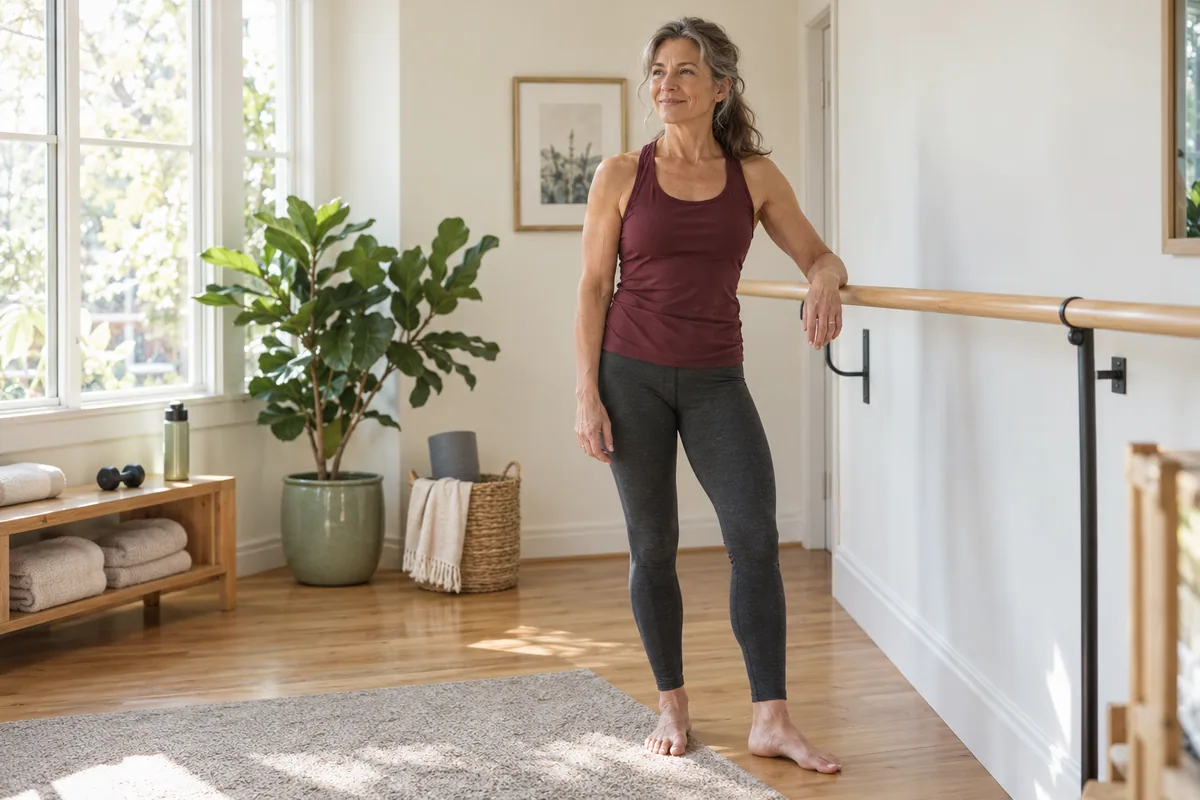
This guide links to demonstrated standing arm, upper-back, hip and calf exercises, and explains what standing core work means. After 50, the useful starting point is the movement you want to learn and the positions you can use, rather than a special set of exercises determined by your age. You can choose an entirely off-floor session without limiting yourself to calf raises.
The resources below show actual exercises from health organizations. They are examples to explore, not a sequence to complete or a prescription for every reader. If you have movement restrictions, use them to ask for a version that fits those restrictions.
Which standing exercises work different body areas?
A balanced selection includes different tasks, rather than several names for the same leg movement. The NHS strength page has illustrated examples, while Mayo Clinic supplies a pulling-exercise video.
On a small screen, scroll the table sideways to see all columns.
| Area or goal | Example to investigate | Important distinction |
|---|---|---|
| Arms and pushing | NHS wall press-up | Bodyweight resistance still loads the hands and wrists. |
| Upper back and pulling | Mayo Clinic resistance-tubing row | Standing does not mean upright throughout; this example involves a hip hinge and knee bend. |
| Hips and glutes | NHS sideways leg lift and standing leg extension | These are different directions of hip movement, not a squat sequence. |
| Calves | NHS supported calf raise | Support and movement control are separate from the number of repetitions. |
Can you strengthen your arms without weights after 50?
Yes. Bodyweight can provide resistance without dumbbells: the NHS wall press-up is one demonstrated example. “Without weights” does not necessarily mean easy, joint-free or equipment-free; you still need a suitable surface and an appropriate version of the task.
For upper-back work, consider what pulling exercise the program includes. Mayo Clinic’s tubing-row video shows one example with a band, which is resistance equipment even though it is not a weight. Check its bent-over position before choosing it. Shoulder or wrist symptoms deserve a more specific discussion than adding arm circles until they burn.
Can standing exercises work your abs and core?
Yes. Core work involves controlling the trunk, not only lying down for crunches. Mayo Clinic explains that the core includes abdominal, back and pelvic muscles working together. A standing resistance exercise may ask those muscles to maintain position while the limbs move.
Ask the teacher: “What is the trunk-control task, and what should stay still?” That is more useful than choosing a fast standing-crunch video solely because it promises a smaller waist. Abdominal work alone does not remove belly fat, as Mayo Clinic’s women’s-health guidance explains. Exercise choice cannot guarantee a particular waistline.
What about inner-thigh exercises for women over 50?
Inner-thigh training and changing thigh appearance are different goals. Hip adduction brings the leg toward the body’s midline; abduction moves it away. A sideways leg lift should not automatically be described as an inner-thigh exercise.
The AAOS hip-conditioning guide labels and illustrates both movements. Its adduction example is side-lying, so it does not meet an entirely standing requirement. If staying off the floor matters, ask an instructor to demonstrate an appropriate standing alternative rather than copying that floor setup or assuming a very wide plié is required. A strength exercise does not guarantee fat loss from the body area it works.
Can you work your glutes without squats or lunges?
Yes. The NHS illustrations include supported sideways leg lifts and a standing backward leg movement, labeled “leg extension,” that do not use a squat or lunge pattern. Open the original demonstration to see the support and body position rather than inventing a larger kick or adding resistance immediately.
Explain why you want to avoid squats: preference, balance, a specific restriction or discomfort are different reasons. Avoiding squats does not remove every demand on the knees, hips or back. Read our joint and class-movement questions if symptoms affect the decision, and our no-floor guide if transitions are the issue.
Are isometric exercises useful after 50?
An isometric exercise holds a muscular contraction without visible movement at the involved joint. It is different from a series of small pulses. Mayo Clinic’s explanation notes that its strength effects are specific to the position trained; a long hold is not a complete full-body plan.
Ask what the hold contributes and how to breathe during it. Do not turn breath-holding or straining into the challenge. If you have high blood pressure or heart problems, discuss isometric exercise with your healthcare professional. Age alone does not select a hold duration or make every static exercise suitable.
How do you choose a standing class or home plan?
Write down three requirements: positions you want to use, resistance available, and the support or instruction you need. Then check the warm-up, main work and finish; an advertised standing section does not establish that the complete class stays off the floor.
The planned Standing Barre format explains class-fit questions; it is not a seated class. For full-body coverage and progression, use our home strength guide after 50 alongside the CDC’s activity guidance. Repeating a favorite arm or glute exercise is not the same as covering all major muscle groups.
BarrePod classes are being planned; bookings are not open. Explore the format information or join the free waitlist to share class and time preferences. Interest does not reserve a session or establish individual suitability.
Sources
References used in this guide. Individual advice and the format of a particular class may differ.