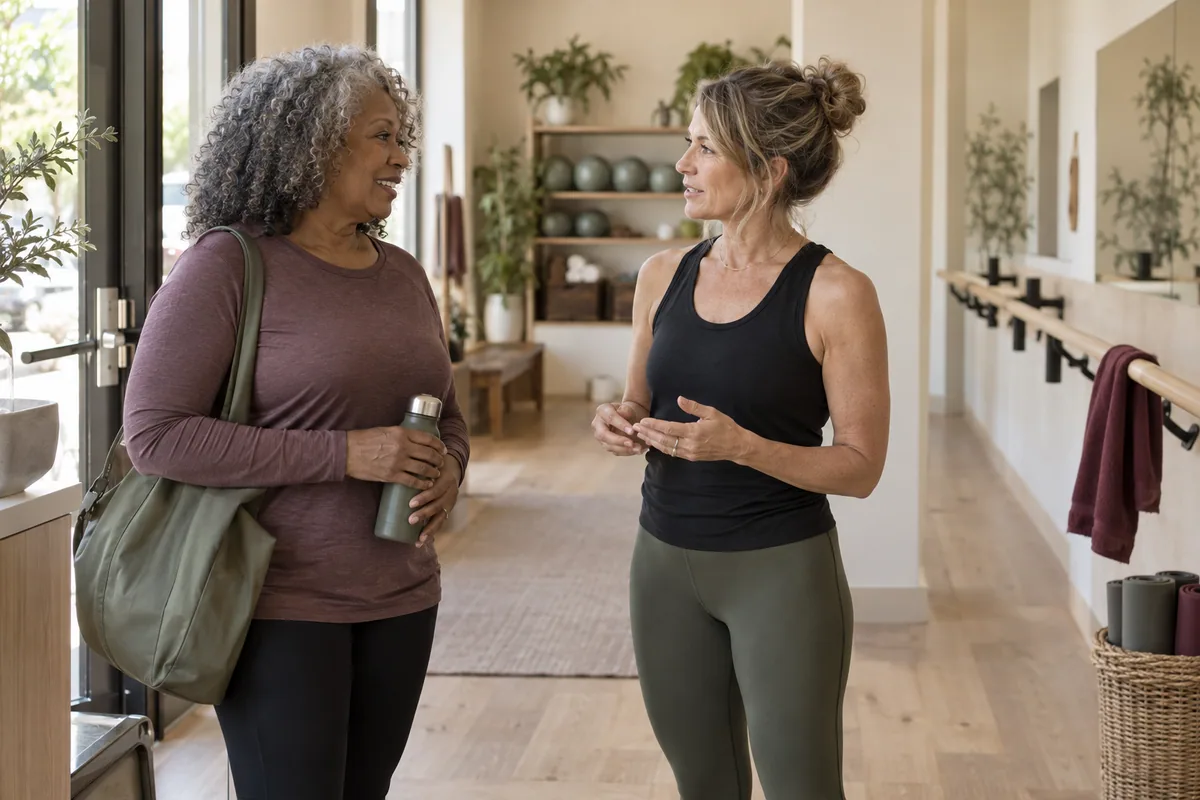
Yes—barre can be a worthwhile activity after 50 if you enjoy the teaching and the session fits your current abilities and goals. You do not need dance experience. The more useful question is what the actual class contributes to your week: resistance work, movement practice, an enjoyable appointment or some combination.
Menopause or perimenopause may change what you want from exercise, but they do not create one class format that every woman needs. Start with your own priorities rather than a promise of a “menopause body” transformation.
How can a beginner start barre after 50?
Choose a class that explains starting positions, offers a learning pace and fits the positions you can use. You can start by asking a provider what happens in the whole session. Dance experience and a particular body shape are not prerequisites for investigating a beginner fitness class.
On a small screen, scroll the table sideways to see all columns.
| Your priority | What to check in a class |
|---|---|
| Learning the basics | Starting positions, clear demonstrations and time to ask questions. |
| Strength | Which muscle groups work against resistance and how challenge develops. |
| Avoiding floor transitions | Whether the warm-up, main section and finish all stay off the floor. |
| A routine you enjoy | Teaching style, music, schedule and an ongoing price you can use. |
An “over 50” label can help you find a welcoming setting. Still ask what is taught: a beginner returning to exercise and an experienced lifter may want different starting points even when they share a birthday year.
Our planned Beginner Barre and Standing Barre information can help you compare learning pace and floor-work questions. These are upcoming formats; use the free waitlist to share preferences while bookings remain closed.
Is barre good for menopause and perimenopause?
Barre can be an enjoyable way to stay active during menopause or perimenopause. The evidence supports physical activity for general health; it does not establish barre as a treatment for hot flashes or hormonal changes. Choose it for the exercise and teaching you want, while discussing disruptive symptoms separately with a clinician.
The Menopause Society’s hot-flash guidance describes exercise as valuable for overall health while noting limited or inconsistent evidence for its use as a hot-flash treatment. Its 2023 nonhormone therapy position statement did not recommend exercise as a treatment for vasomotor symptoms. Neither source establishes a special menopause-treatment effect from barre.
You can value a class because it feels enjoyable and manageable without asking it to treat symptoms. If hot flashes, disrupted sleep or another change is affecting daily life, discuss that separately with a healthcare professional. A fitness provider should be able to keep the teaching conversation useful while respecting that distinction.
Is barre enough for strength and bone health after 50?
Look at your whole activity routine. CDC adult guidance includes aerobic activity and muscle strengthening; attending a class does not tell you which parts it covers. Ask what resistance the exercises provide and how the instructor knows when to adjust it.
A long sequence with light weights may be challenging, but a burning sensation does not answer whether your strength goals are being met. Our home strength guide after 50 explains how to discuss equipment and progression without choosing one weight for everyone.
NIAMS bone-health guidance distinguishes weight-bearing, resistance and balance activities. It also recommends individual advice for osteoporosis or low bone density. A barre class name cannot identify the movements appropriate for a particular fracture risk.
What should you ask before your first barre class?
Describe a practical requirement: “I need to avoid kneeling,” “I want the positions explained before the sequence starts,” or “I want to understand how the resistance progresses.” Ask which options the teacher demonstrates and whether you can discuss the setup beforehand.
For online participation, check the camera view, audio and way to ask questions. For any setting, confirm equipment and transitions. The guide to exercise without floor work helps distinguish standing beside a chair from exercising in a seat throughout.
If choosing between methods is your main question, the barre, Pilates and yoga comparison helps you compare actual sessions. There is no need to declare one method best for every woman in midlife.
Is Pure Barre good for older women?
It may be an option if the particular class fits your starting level, movement needs and teaching preferences. Pure Barre’s official format descriptions show that its sessions differ. Ask the studio which introduction and alternatives it offers, rather than assuming age determines a single suitable format.
Our Pure Barre comparison helps you investigate cost, teaching and other options. This is provider-selection guidance, not evidence that a named format treats menopause or osteoporosis.
How do you know whether a barre class fits?
Shortlist a session and ask one unresolved question before committing. After trying a suitable class, notice whether you could follow the instructions, use the setup and imagine returning. That tells you more about practical fit than comparing yourself with a demonstration or another participant.
Use the online fitness comparison for women over 50 if delivery and feedback are your next decisions.
BarrePod is preparing live online 30-minute group classes. The planned offer is USD $9.95 each for the first three eligible classes, then $19.95 each. The three introductory classes are one shared allowance across formats. See pricing or join the free waitlist to share your interests and preferred times. Bookings are not open yet.
Sources
References used in this guide. Individual advice and the format of a particular class may differ.